KarlTrain
A Caltrain app for iPhone.
Departures between two stations, live train positions, arrival alarms, service alerts and transfer information. It's free and there's no account to make.
The departure board
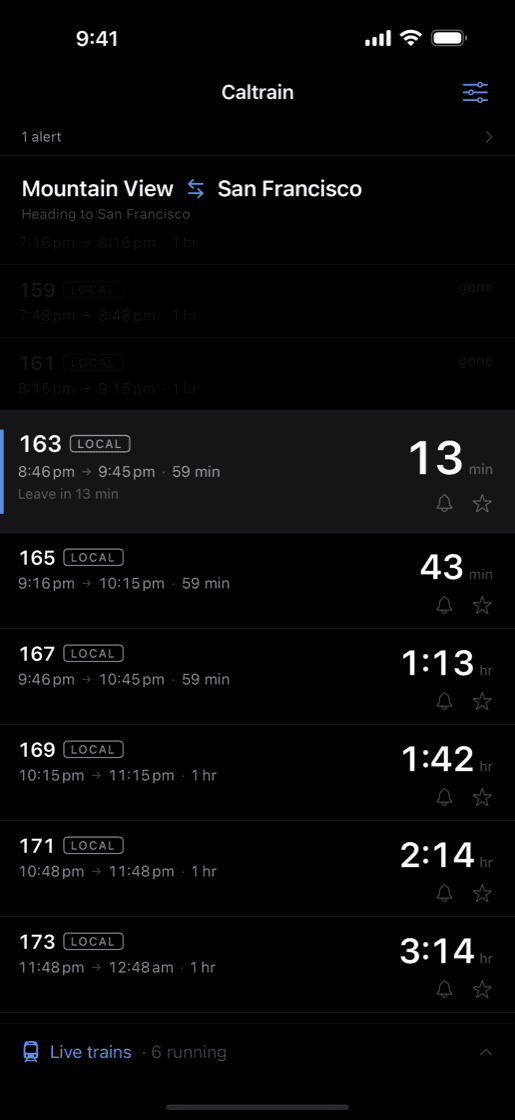
Pick the station you're leaving from and the one you're going to, and you get every train between them for the rest of the day, with the minutes until each one set in the largest type on the row so you can read it at arm's length on a platform.
Each train shows when it leaves, when it lands, how long it sits on board, and whether it's a Local, a Limited or an Express, which on this line is the difference between fifty-nine minutes and ninety. Trains that have already gone stay on the list, greyed out.
An alarm for your stop
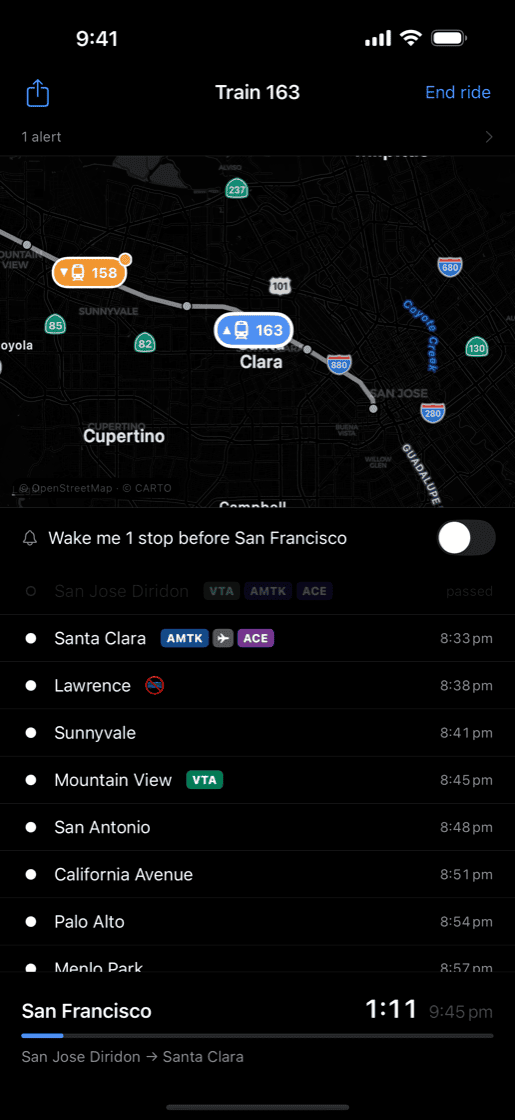
Switch it on and the phone wakes you one calling stop before you get off, which gives you a few minutes to find your bag and your jacket instead of the eight seconds between the doors opening and closing.
It counts the stops your train actually calls at, which matters on an express where the stop before yours can be twenty miles back up the line. If the train is running late the alarm moves with it, and it still goes off in the tunnel where there's no signal. A second one afterwards reminds you to tag off your Clipper card.
Where the trains are
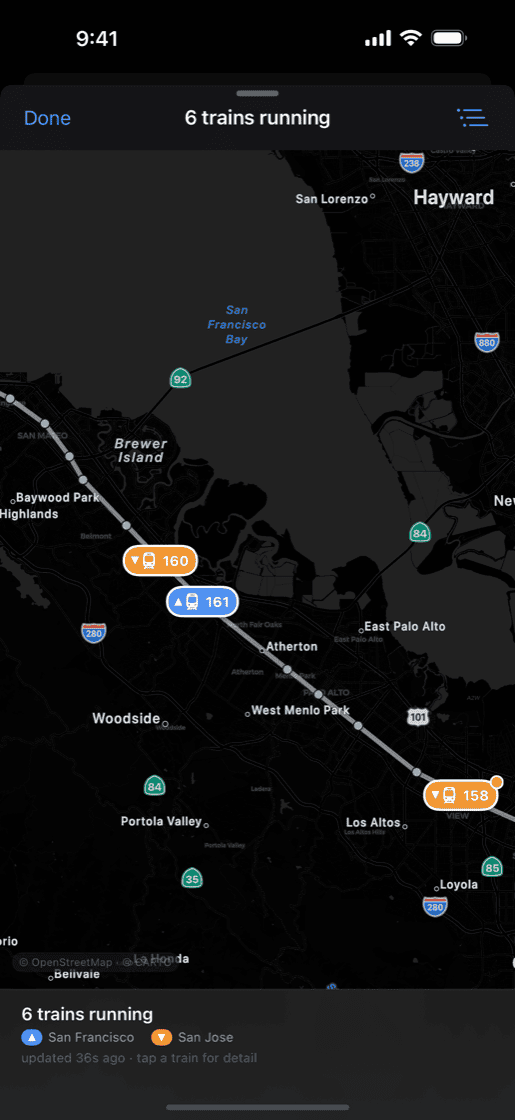
A map of every train currently running on the line, drawn on the rails so the one you're waiting for lines up with where you're standing. Northbound and southbound are different colours, and each pin carries the train's number.
The trains move continuously, and one slowing into a platform slows down on the map too.
The whole line at once
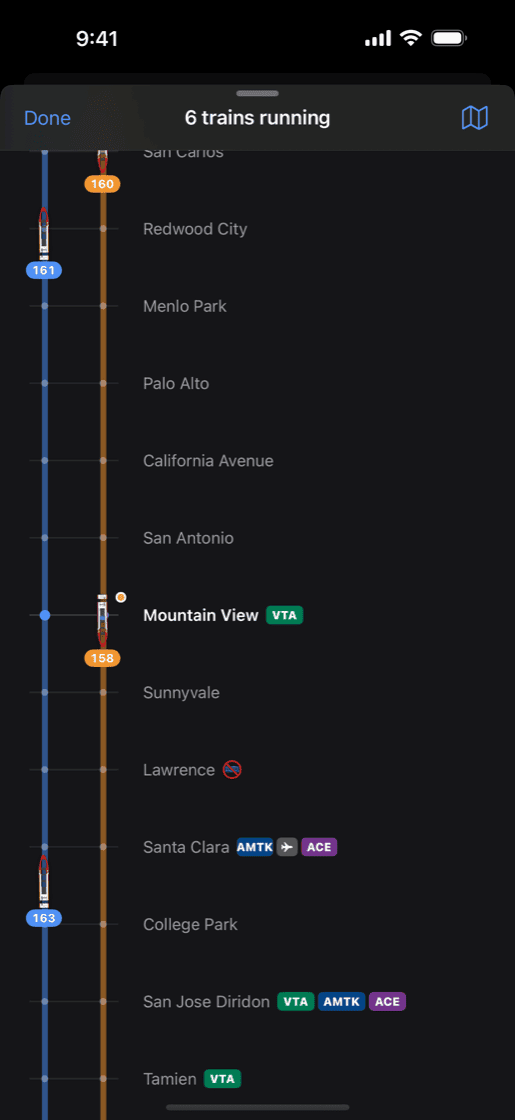
The same trains as a strip diagram: two tracks down the left, all thirty stations down the right, and the trains sliding between them. It's the view that answers how far away is mine and what's between here and there without any panning or zooming.
Stations where you can change to BART, Muni Metro, VTA, Amtrak or ACE are marked as such, and so is the one station on the line with no bus stop within walking distance of the platform.
One train, every stop
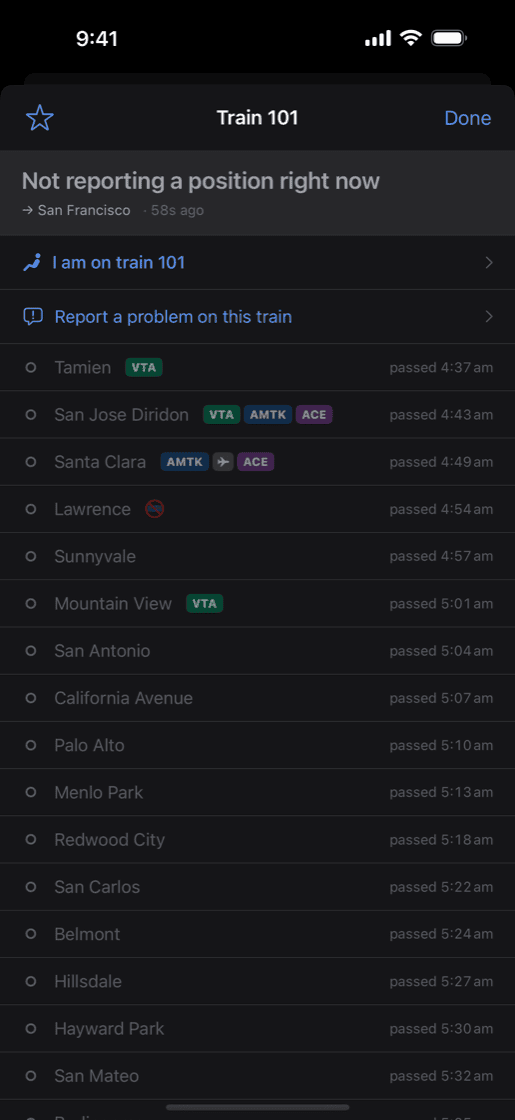
Open any train and you get its full list of calls with the time it reaches each one, which is what you want when you're deciding whether to run for the express or wait eight minutes for the local that actually stops where you're going.
You can set a reminder here, and the phone tells you when it's time to leave for the platform, pushed later automatically if the train is delayed. You can also send someone a link that shows them where you are and when you'll arrive, which stops working by itself after six hours.
What's gone wrong today
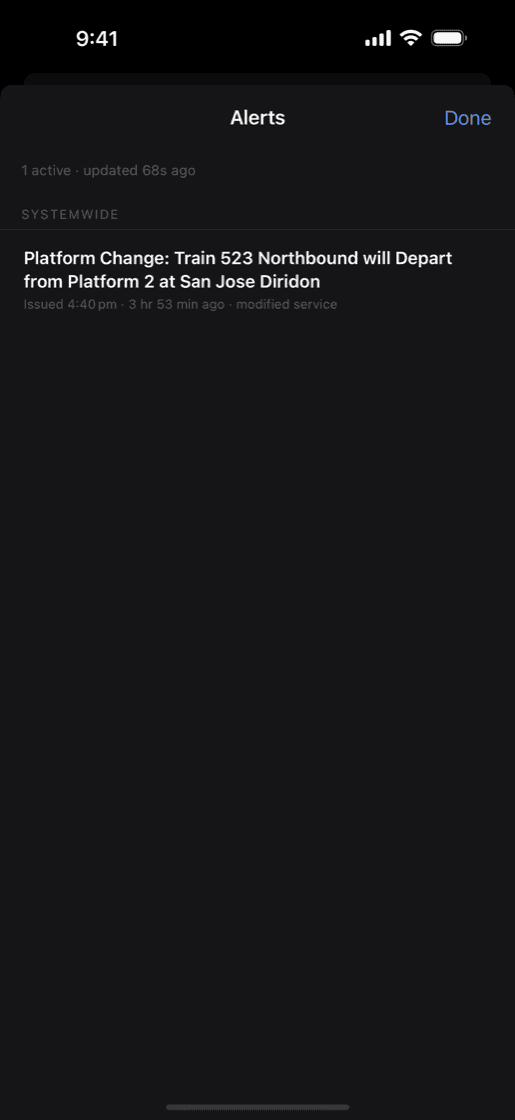
Caltrain's own service alerts, filtered down to the two stations you actually use, so a signal problem in Gilroy doesn't interrupt a commute between Palo Alto and San Francisco.
At stations where you can change to another railway, that railway's alerts appear too, because a Muni Metro outage is your problem the moment you step off at Fourth and King. Riders can also flag a broken toilet, a full bike car, no air conditioning or bad Wi-Fi on a specific train.
It works without knowing where you are
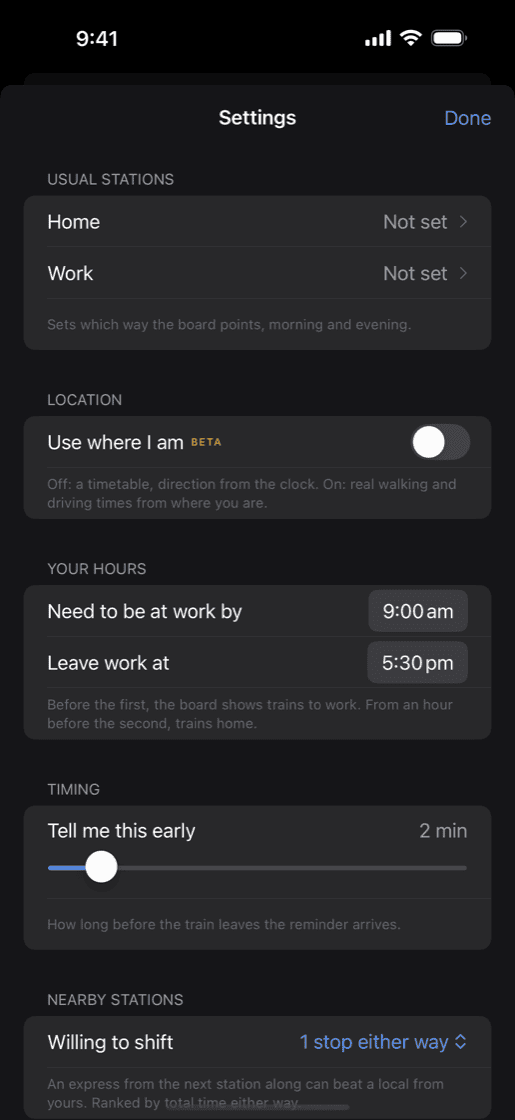
Location is switched off when you install the app, and everything above works with it off. The app picks your direction from the clock and the two stations you ride between, which is enough to know that at half past five you want the trains going home.
Turning it on picks your station for you, measures the walk or drive to the platform, and works out which train you're sitting on so the alarm can be set without telling it. Your position is used on the phone and isn't sent anywhere.